马达加斯加菊石化石 Ammonite fossil from Madagascar (© ThomasLENNE/Shutterstock)

马达加斯加菊石化石 Ammonite fossil from Madagascar (© ThomasLENNE/Shutterstock)
大自然的秘密代码 Nature's secret code
斐波那契日
仔细观察这块菊石化石。它那优雅盘旋的螺壳,曾是史前海洋生物的家,如今却蕴藏着一个数学的秘密:螺旋结构。每一个新的壳室都比前一个按比例增大,保持着恒定的生长比,这种规律常被认为与斐波那契数列密切相关。
每年的11月23日,人们都会庆祝斐波那契日,以纪念这位13世纪的意大利数学家。然而,这一数列的最早记载可追溯至公元前200年,由古印度诗人兼数学家品迦拉首次提出。他描述了这样的序列:1、1、2、3、5、8……每个数字都是前两个数字之和。斐波那契数列广泛存在于自然界之中,从菠萝、洋蓟、松果到植物茎上的排序,都能看到它的影子。
菊石是一类生活在距今约4亿年至6600万年前的软体动物,它们在远古海洋中滑行,螺旋壳保护柔软的身体。死亡后,壳体被沉积物掩埋,矿物质在漫长岁月中渗入其中,将这份自然的几何美永久定格。如今,菊石化石静静提醒着我们:数学与自然,其实说着同一种语言。
Fibonacci Day
Look closely at this ammonite fossil. Its swirling shell, once home to a prehistoric sea creature, holds a mathematical secret—a spiral pattern. Each new chamber is proportionally larger than the previous one, maintaining a consistent growth ratio, often associated with the Fibonacci sequence.
Each November 23, we celebrate Fibonacci Day, named after the 13th-century Italian mathematician Leonardo Bonacci (Fibonacci), who introduced the concept to Europe. The pattern 1, 1, 2, 3, 5, 8…—where each number is the sum of the two before it—was, however, first described in India as early as 200 BCE by the ancient poet-mathematician Pingala. The Fibonacci sequence appears widely in nature, including pineapples, artichokes, pinecones, and the arrangement of leaves on a stem.
Ammonites were mollusks that lived between 400 and 66 million years ago, gliding through ancient seas inside coiled shells that protected their soft bodies. When ammonites perished, sediment buried their shells, and minerals slowly turned them to stone, preserving this natural geometry for millions of years. Today, the ammonite fossil is a striking reminder that math and nature speak the same language.
侏罗纪时期的鱼龙化石,英国多塞特 An ichthyosaur fossil of the Jurassic period, Dinosaurland Fossil Museum, Lyme Regis, Dorset, England (© Christopher Jones/Alamy)
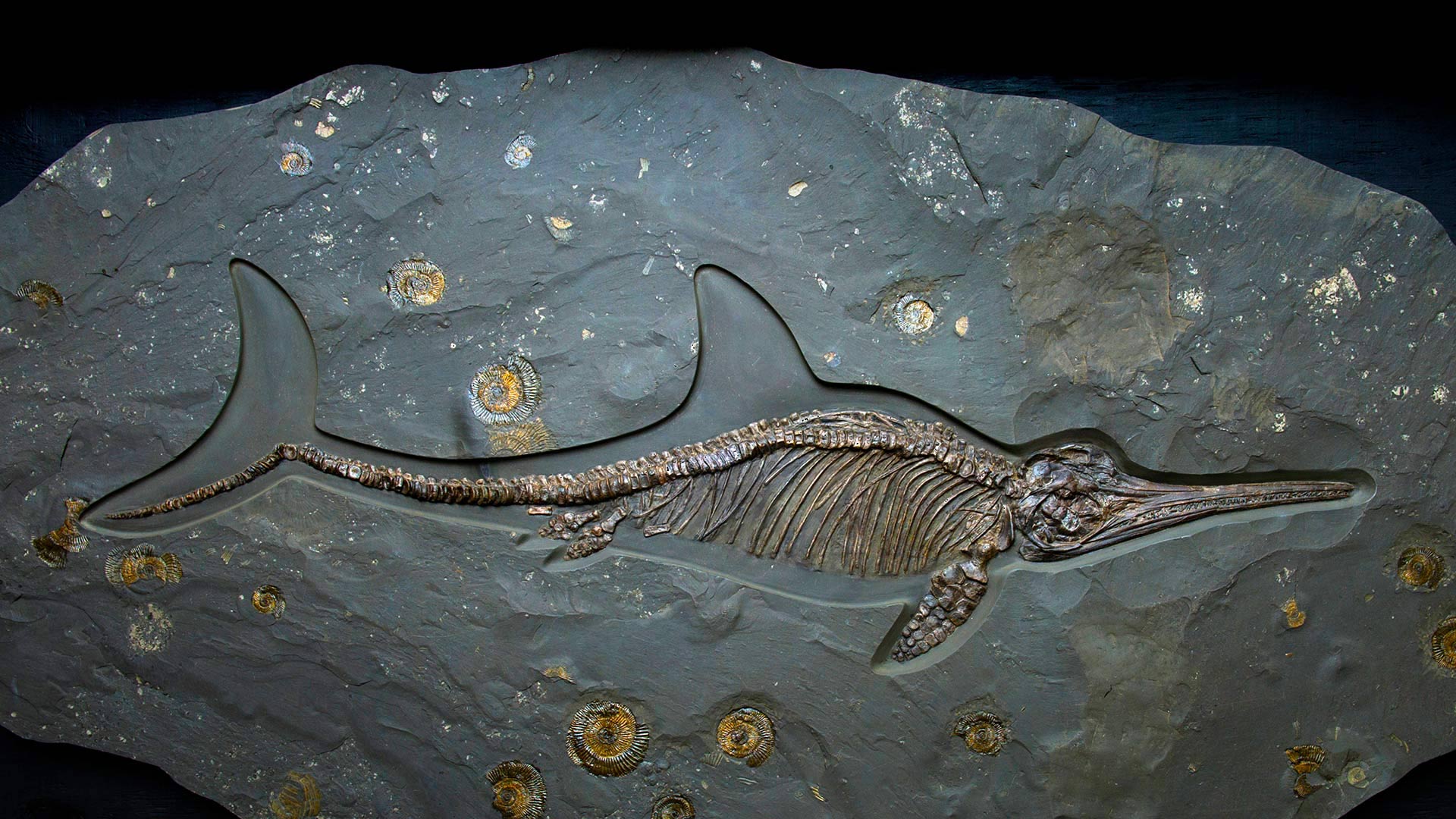
侏罗纪时期的鱼龙化石,英国多塞特 An ichthyosaur fossil of the Jurassic period, Dinosaurland Fossil Museum, Lyme Regis, Dorset, England (© Christopher Jones/Alamy)
Celebrating a young girl's age-old discovery
When 12-year-old Mary Anning uncovered the complete skeleton of a fish-like creature near her home on England's southern coast in 1811, extinction was a shaky idea in science. Fossils were nothing new—everything dies and leaves remains, after all. But could an entire species really die off? Were more of these 17-foot sea monsters lurking in the depths of the English Channel?
The fact that ichthyosaurs like this went extinct 90 million years ago seems obvious today (which, by the way, is National Fossil Day). But though such definite answers were still only suspicions during Mary Anning's lifetime, she persisted with paleontology. Her prolific fossil finds fueled both public interest and scientific understanding, and she even discovered two more species in her 20s: the pterodactyl and the plesiosaur. Though she died young at 47, largely denied recognition as a woman in Victorian society, her influence endures like the fossils that fascinated her.
庆祝一个年轻女孩的古老发现
1811年,当12岁的玛丽·安宁(Mary Anning)在她位于英格兰南部海岸的家附近发现了一具鱼形生物的完整骨架时,灭绝在科学上是一个不可靠的想法。化石并不是什么新鲜事,毕竟,一切都会死去,树叶也会留下。但整个物种真的会灭绝吗?这些17英尺高的海怪中有更多潜伏在英吉利海峡深处吗?
像这样的鱼龙在9000万年前灭绝的事实在今天看来是显而易见的(顺便说一句,这是国家化石日)。但尽管在玛丽·安宁的一生中,这些明确的答案仍然只是怀疑,但她坚持使用古生物学。她丰富的化石发现激发了公众兴趣和科学理解,她甚至在20多岁的时候又发现了两个物种:翼手龙和蛇颈龙。尽管她英年早逝,享年47岁,在维多利亚时代基本上被否认是一名女性,但她的影响就像让她着迷的化石一样持久。