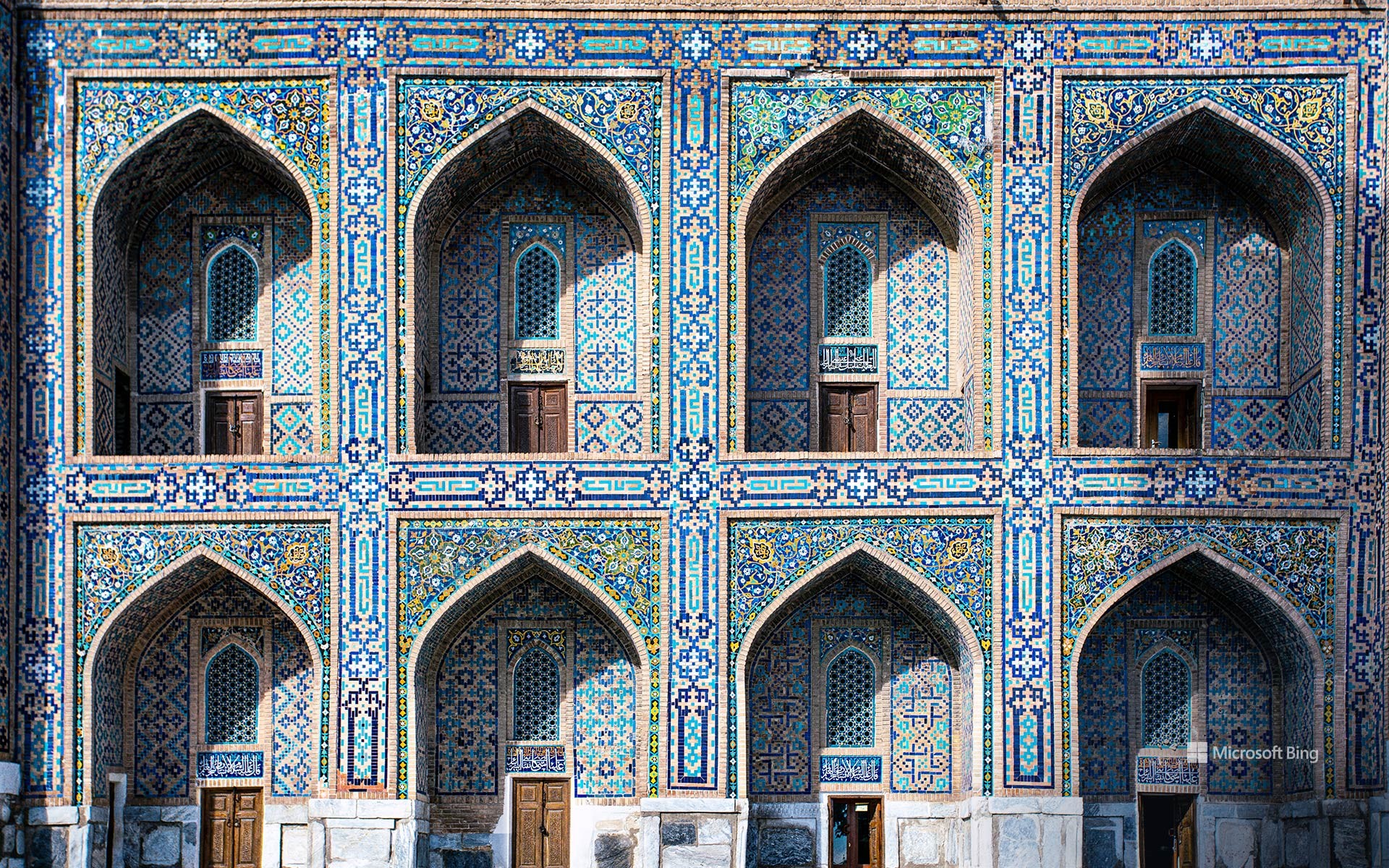
雷吉斯坦广场的建筑细节,撒马尔罕,乌兹别克斯坦 Building detail of Registan Square, Samarkand, Uzbekistan (© Piero M. Bianchi/Getty Images)

雷吉斯坦广场的建筑细节,撒马尔罕,乌兹别克斯坦 Building detail of Registan Square, Samarkand, Uzbekistan (© Piero M. Bianchi/Getty Images)
图案艺术的典范 A master class in pattern
雷吉斯坦广场的建筑细节
站在雷吉斯坦广场上,你很容易明白为什么这里被视为撒马尔罕的建筑核心——撒马尔罕是中亚最古老的城市之一。这座位于乌兹别克斯坦的广场三面矗立着三座宏伟的经学院——伊斯兰学术中心——它们高耸的门廊吸引着人们仰头观望。然而,广场上一些最珍贵的瑰宝,只有在你走近细看时才会显露出来。
今日图片中的细节让我们得以一窥几乎遍布每一处表面的精美艺术。琉璃砖、几何图案、花卉纹饰和优雅的书法以非凡的精确度融为一体,将砖石与灰泥化作绚丽夺目的色彩和图案展示。绿松石色、钴蓝色、金色和白色的色调随着光线变化而流转,使建筑在一天之中呈现出一种动态之感。
这些经学院最初作为学习和宗教学术研究中心而建,环绕着一座热闹的公共广场;这里曾是丝绸之路沿线的生活中心。如今,雷吉斯坦依然同样引人入胜,吸引游客欣赏其宏伟的规模和非凡的工艺。
Building detail of Registan Square, Samarkand, Uzbekistan
Stand in Registan Square and it's easy to see why it is considered the architectural heart of Samarkand—one of Central Asia's oldest cities. This plaza in Uzbekistan is framed by three magnificent madrasas—Islamic centers of learning—whose soaring portals draw the eye upward. Yet some of the square's greatest treasures reveal themselves only when you look closer.
The detail in today's image offers a glimpse of the artistry that covers nearly every surface. Glazed tiles, geometric motifs, floral designs, and elegant calligraphy come together with remarkable precision, turning brick and plaster into a dazzling display of color and pattern. Shades of turquoise, cobalt, gold, and white shift with the changing light, giving the architecture a sense of movement throughout the day.
Built as centers of learning and religious scholarship, the madrasas surrounded a lively public square that was once a focal point of life along the Silk Road. Today, Registan remains just as captivating, inviting visitors to admire both its monumental scale and its extraordinary craftsmanship.
雷吉斯坦广场的外立面马赛克,撒马尔罕,乌兹别克斯坦 Mosaic façade in Registan Square, Samarkand, Uzbekistan (© da-kuk/Getty Images)
雷吉斯坦广场的外立面马赛克,撒马尔罕,乌兹别克斯坦 Mosaic façade in Registan Square, Samarkand, Uzbekistan (© da-kuk/Getty Images)
瓷砖的故事 Tile tales
雷吉斯坦广场,撒马尔罕,乌兹别克斯坦
准备好了吗?让我们一起踮起脚尖进入乌兹别克斯坦撒马尔罕市的雷吉斯坦广场。在波斯语中,雷吉斯坦意为“沙地”或“沙漠”,它是帖木儿帝国时期的活动中心。广场上的建筑风格体现了“帖木儿文艺复兴”的精髓,这是一个文化和知识复兴的时期,在公元14世纪至16世纪初期席卷了整个穆斯林世界。
在这个宏伟的广场上,市民们曾聚集在一起,聆听皇家的公告。皇家的公告是通过一个被称为“dzharchis”的巨大铜管发出的,声音非常得铿锵有力。广场周围环绕着三个伊斯兰学校,即乌鲁格别克书院、悉多书院以及提拉卡力清真寺及书院,它们具有独特的伊斯兰建筑风格,典型特点是采用了精致的重复图案和装潢样式。雷吉斯坦广场壮丽的建筑风格影响深远,从波斯的萨非王朝古迹到印度和巴基斯坦的莫卧儿王朝建筑都受其影响。不仅如此,在遥远的地方也有建筑受到了它的影响,例如20世纪初俄罗斯的圣彼得堡清真寺。
Registan, Samarkand, Uzbekistan
Welcome to the blue hues of the Registan, a public square at the heart of the city of Samarkand, Uzbekistan. Meaning 'sandy place' in Persian, Registan was a center of activity during the Timurid Renaissance, a period of cultural and intellectual revival in the Muslim world between the 14th and early 16th centuries.
In this grand square, citizens came together to hear royal proclamations, announced with resounding blasts from colossal copper pipes known as dzharchis. The square is encircled by three Islamic schools, namely the Ulugh Beg Madrasah, the Sher-Dor Madrasah, and the Tilya-Kori Madrasah, characterized by the Islamic architectural style, which typically features elaborate repetitive patterns and ornamental forms. Registan's architectural influence is seen far and wide, from the Safavid monuments of Persia and the Mughal buildings of India and Pakistan to the early 20th-century Saint Petersburg Mosque in Russia.