让-马里·吉巴乌文化中心,新喀里多尼亚 Jean-Marie Tjibaou Cultural Centre, New Caledonia (© Fabien Astre/Alamy)

让-马里·吉巴乌文化中心,新喀里多尼亚 Jean-Marie Tjibaou Cultural Centre, New Caledonia (© Fabien Astre/Alamy)
身份认同的建筑表达 Architecture of identity
世界土著人民国际日
今天,世界土著人民国际日邀请我们更深入地了解那些历史远早于文字记载的社群。联合国于1994年设立这一纪念日,并于1995年首次举行活动;日期所纪念的是1982年一次致力于保护全球土著人民权利的重要会议。如今,约90个国家生活着超过4.76亿土著人民,他们延续着数千种文化,也传承着全球约7,000种语言中的大多数。
在新喀里多尼亚蒂纳半岛,吉巴乌文化中心生动展现了这种鲜活遗产。该中心由伦佐·皮亚诺设计,于1998年开放。高耸的弧形建筑以现代材料和技术呼应卡纳克传统茅屋;蜿蜒小径连接艺术、研究与表演空间,体现文化、土地和社群之间的联系。
这个纪念日不仅为了认可土著人民,也提醒我们:在迅速变化的世界中,土著知识仍在影响人类保护生态系统、传承语言和定义身份的方式。
International Day of the World's Indigenous Peoples
Today, the International Day of the World's Indigenous Peoples invites a closer look at communities whose stories stretch far beyond recorded history. Proclaimed by the United Nations in 1994 and first observed in 1995, the date marks a landmark 1982 meeting focused on protecting Indigenous rights worldwide. More than 476 million Indigenous people now live across about 90 countries, sustaining thousands of cultures and the majority of the world's roughly 7,000 languages.
On New Caledonia's Tina Peninsula, the Jean-Marie Tjibaou Cultural Centre offers a vivid expression of that living heritage. Designed by Renzo Piano and opened in 1998, its tall, curved structures echo traditional Kanak huts while using modern materials and techniques. Winding paths link spaces for art, research, and performance, reflecting the connection between culture, land, and community.
The day isn't only about recognition—it's a reminder that Indigenous knowledge continues to shape how people protect ecosystems, pass down languages, and define identity in a rapidly changing world.
阿根廷圣克鲁斯的洛斯马诺斯洞穴 Cueva de las Manos (Cave of the Hands) in Santa Cruz, Argentina (© Adwo/Alamy)
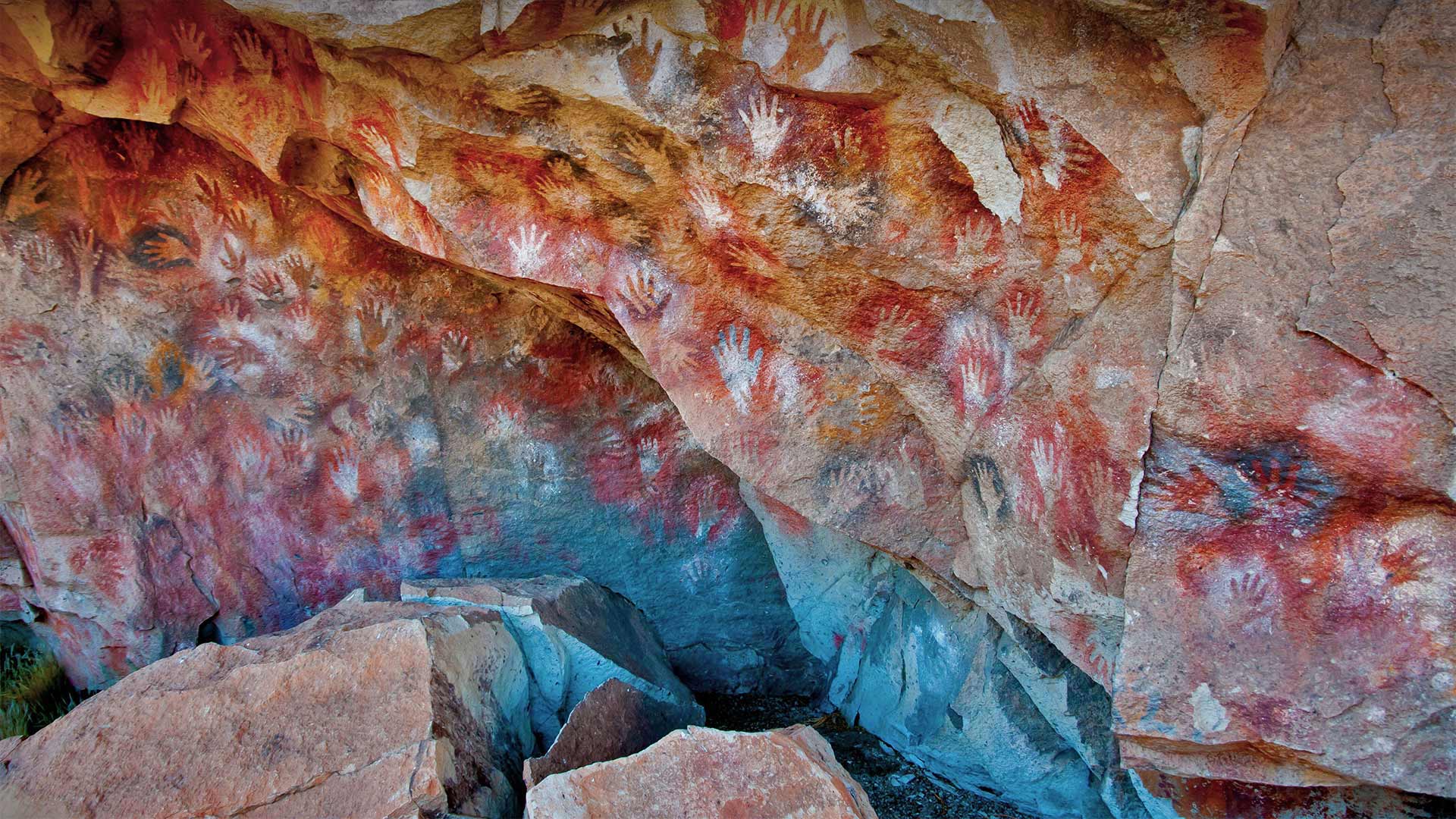
阿根廷圣克鲁斯的洛斯马诺斯洞穴 Cueva de las Manos (Cave of the Hands) in Santa Cruz, Argentina (© Adwo/Alamy)
9000年前的手印 9,000-year-old handprints
International Day of the World's Indigenous Peoples
What at first glance appears to be graffiti tagged on a rock wall is, in fact, artwork created by the first human settlers of this remote region deep in Argentine Patagonia. It's thought that the cave paintings were made between 13,000 and 9,500 years ago. The archaeological site is known in Spanish as the Cueva de las Manos (Cave of the Hands). It's the largest display of prehistoric handprints in the world, made all those years ago by people holding a hand against the rock wall and blowing pigments through tubes made of bone. Of the 829 black, white, red, and ochre prints, most are of young male hands. One print has six fingers, and only 31 are of right hands.
The cave paintings were created in at least three waves over thousands of years by ancestors of the Tehuelche people. Archaeologists have hypothesized that the artists were hunter-gatherers. This theory is supported by the fact that even older than the handprints are depictions of guanacos (a relative of the llama, and the main source of food at the time); rheas (large flightless birds); and hunting scenes.
Today, more than 370 million Indigenous people live in various regions of the world, like the Teheulche, who continue to live in Patagonia near the southern border between Argentina and Chile. To honor and protect the rights of the world's current Indigenous populations, the UN marks each August 7 as International Day of the World's Indigenous Peoples. We'll raise our hands in support of that.
世界土著人民国际日
乍一看,岩壁上的涂鸦标记实际上是阿根廷巴塔哥尼亚这个偏远地区的第一批人类定居者创作的艺术品。据认为,这些洞穴壁画是在13000年至9500年前绘制的。该考古遗址在西班牙语中被称为Cueva de las Manos(手洞)。这是世界上最大规模的史前手印展示会,多年前,人们用手抵着岩壁,用骨头制成的管子吹颜料。在829张黑、白、红和赭色的照片中,大多数是年轻男性的手。一个指纹有六个手指,只有31个是右手的。
这些洞穴壁画是特韦尔奇人的祖先在数千年中至少三次创作的。考古学家假设这些艺术家是狩猎采集者。这一理论得到了以下事实的支持:比手印更古老的是美洲驼(美洲驼的亲戚,当时的主要食物来源)的描述;大型不会飞的鸟类;还有狩猎场面。
今天,有3.7亿多土著人生活在世界各地,如特霍尔切人,他们继续生活在阿根廷和智利南部边界附近的巴塔哥尼亚。为了尊重和保护当今世界土著居民的权利,联合国每年8月7日都将其定为世界土著人民国际日。我们将举手表示支持。