位于阿肯色州和密西西比州交界处的密西西比河 Mississippi River on the border between Arkansas and Mississippi (© NASA)
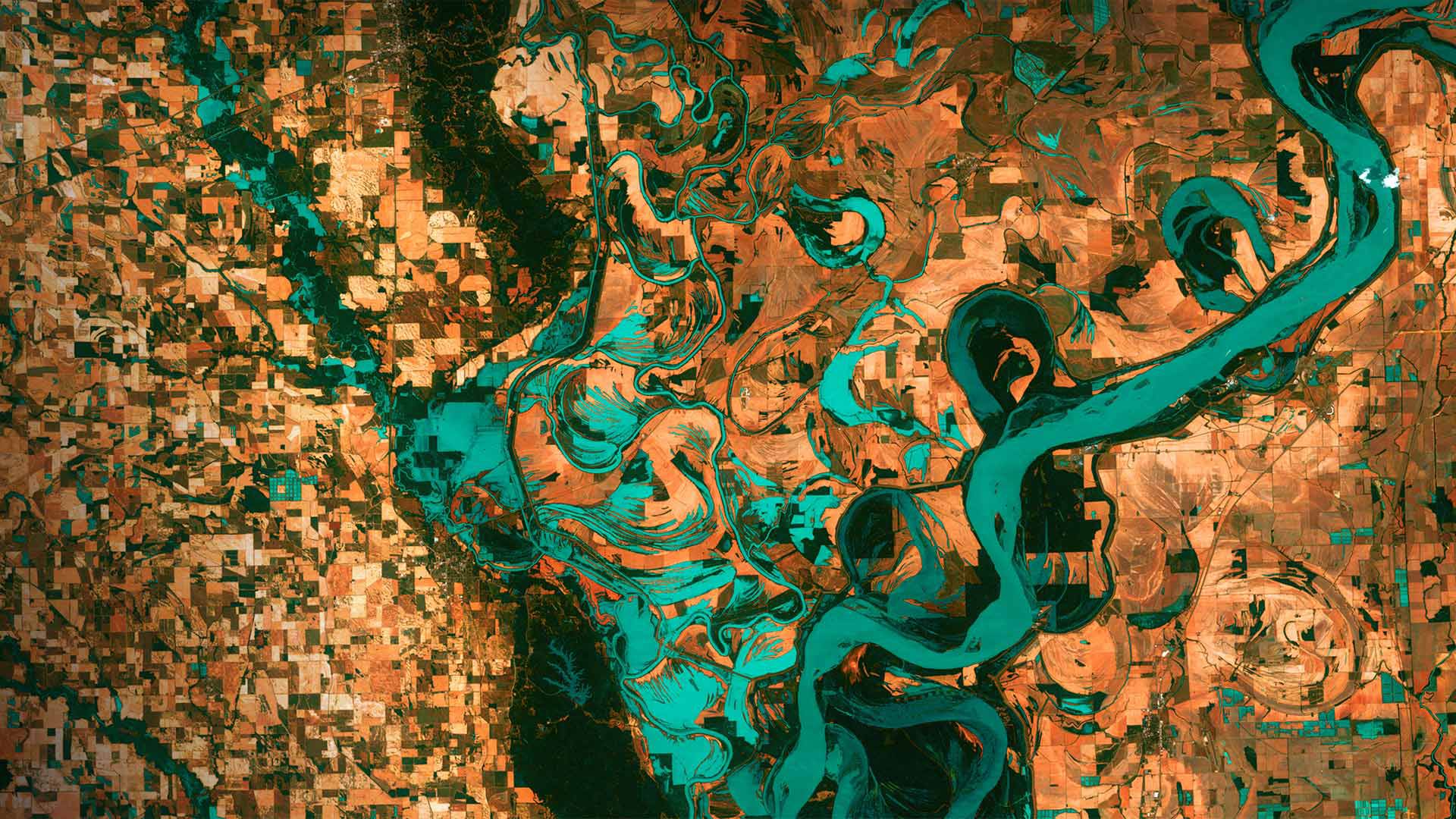
位于阿肯色州和密西西比州交界处的密西西比河 Mississippi River on the border between Arkansas and Mississippi (© NASA)
Gazing down on planet Earth
It's Earth Day today and we are high above the blue marble looking down on the border between Arkansas and Mississippi. Those small, blocky shapes are towns, fields, and pastures–the teal green is the mighty Mississippi River. Anyone who has flown in the window seat of an airplane and has gazed down at Earth below might wonder why the colors in this image are so unreal. That's because they are. These images were taken in 2013 by Landsat 7, a NASA satellite that uses thermal infrared sensors to help scientists better distinguish flora, fauna, water, and manmade objects. For almost 50 years, NASA has been using satellite imagery to understand how climate change and population growth are affecting our fragile planet. These satellites help NASA see where deforestation and wildfires are happening, where glaciers are melting, and how rising waters are encroaching on cities.
The biggest cause of these changes? According to NASA, it's us. Since the first Landsat launched in 1972, the Earth's population has almost doubled, from 4 billion people then to 7.8 billion today. But there is some good news to mark this Earth Day: The Mississippi River we see here is much less toxic now than it was back in 1972, thanks to environmental laws and regulations.
俯瞰地球
今天是地球日,我们在阿肯色州和密西西比州交界处的蓝色大理石上方俯瞰。那些小而块状的形状是城镇、田野和牧场——青绿色是浩瀚的密西西比河。任何坐过飞机靠窗座位的人,都可能会想,为什么这张照片中的颜色如此不真实。那是因为他们是。这些图像是2013年由美国宇航局的陆地卫星7号拍摄的,该卫星使用热红外传感器帮助科学家更好地区分动植物、水和人造物体。近50年来,美国宇航局一直在利用卫星图像来了解气候变化和人口增长是如何影响我们这个脆弱的星球的。这些卫星有助于美国宇航局了解森林砍伐和野火正在发生的地方,冰川正在融化的地方,以及上涨的海水如何侵蚀城市。
这些变化的最大原因是什么?据美国宇航局说,是我们。自从1972年第一颗陆地卫星发射以来,地球人口几乎翻了一番,从当时的40亿人增加到今天的78亿人。但是,有一些好消息值得纪念这个地球日:由于环境法律和法规,我们在这里看到的密西西比河现在的毒性比1972年时要小得多。
木星及木卫一的蒙太奇图像 Montage of images of Jupiter and its volcanic moon Io (© NASA/Johns Hopkins University Applied Physics Laboratory/Southwest Research Institute/Goddard Space Flight Center)
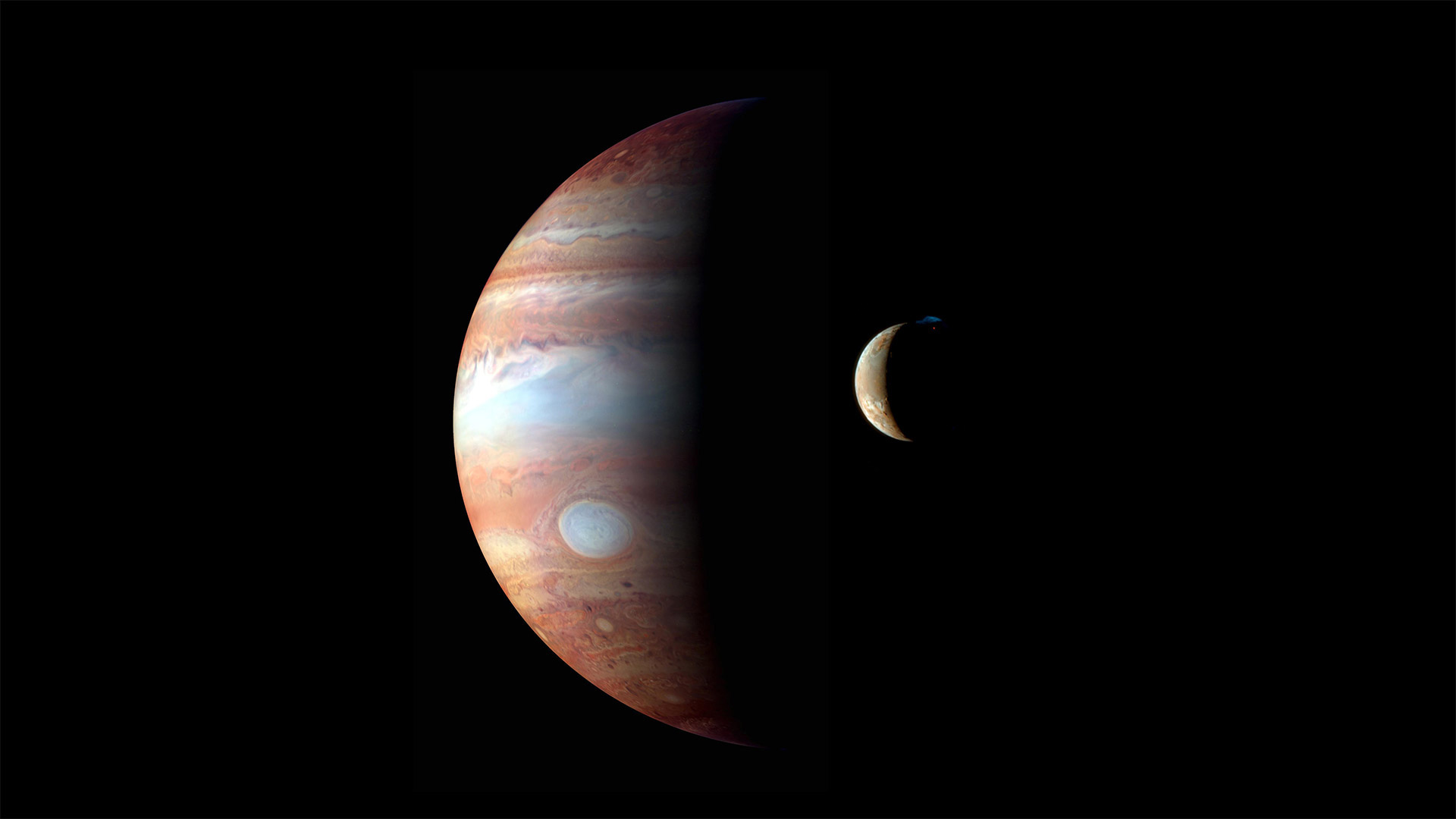
木星及木卫一的蒙太奇图像 Montage of images of Jupiter and its volcanic moon Io (© NASA/Johns Hopkins University Applied Physics Laboratory/Southwest Research Institute/Goddard Space Flight Center)
Infrared Jupiter, erupting Io
To celebrate World Space Week, we're featuring this montage of images of Jupiter courtesy of the New Horizons probe's flyby of the planet in 2007. If Jupiter looks a little different than you're used to seeing, it's because it was imaged using the space probe's near-infrared imaging spectrometer. In this false-color image, Jupiter's high-altitude clouds, like its stormy Great Red Spot, are rendered white, while deeper cloud formations take on reddish hues. The planet's innermost moon, Io, is captured in a true-color composite image during one of its frequent volcanic eruptions. A close look will show lava is glowing red beneath the blue and white plume of particles being ejected into the moon's thin atmosphere.
Space Week is a UN-recognized event that runs each year from October 4, which is the anniversary of the launch of Sputnik in 1957, to October 10, the anniversary of the signing of the Outer Space Treaty in 1967. This year's theme is 'Satellites Improve Life.'
由哈勃太空望远镜拍摄的大麦哲伦星云 The Large Magellanic Cloud, photographed by the Hubble Space Telescope (© ESA/Hubble/NASA)
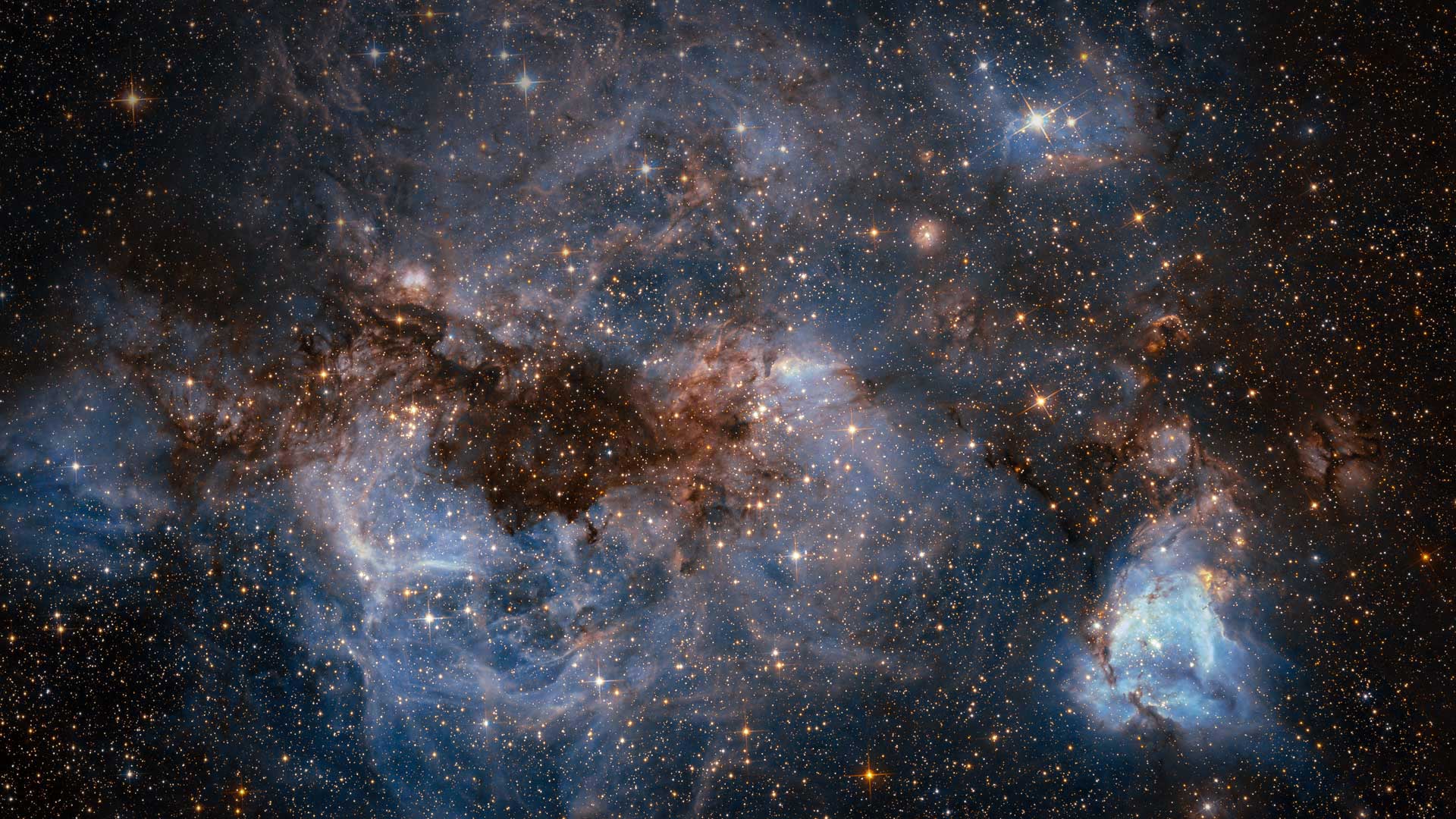
由哈勃太空望远镜拍摄的大麦哲伦星云 The Large Magellanic Cloud, photographed by the Hubble Space Telescope (© ESA/Hubble/NASA)
Celebrating 30 years of eye-opening images
On this day in 1990, the Hubble Space Telescope entered orbit in the cargo bay of the space shuttle Discovery. Shortly thereafter, it began its continuing mission to capture images of our universe from low Earth orbit, free of the obstructions of clouds and the distortions of the atmosphere. Like its namesake, the great astronomer Edwin Hubble, the Hubble Space Telescope has transformed our understanding of the cosmos. Some of the telescope's greatest contributions include its Deep Field Images—which peer back billions of lightyears—or its with jaw-dropping images of objects closer to home, like the one on today's homepage, which shows a maelstrom of glowing gas and dark dust within one of the Milky Way's satellite galaxies, the Large Magellanic Cloud.
NASA estimates that Hubble's mission will continue for another 10-20 more years. Next year, it will be joined in orbit by the James Webb Space Telescope, which will be able to peer even farther into space and with greater sensitivity across more wavelengths.
NASA astronaut works on International Space Station during a spacewalk in 2006 (© NASA)
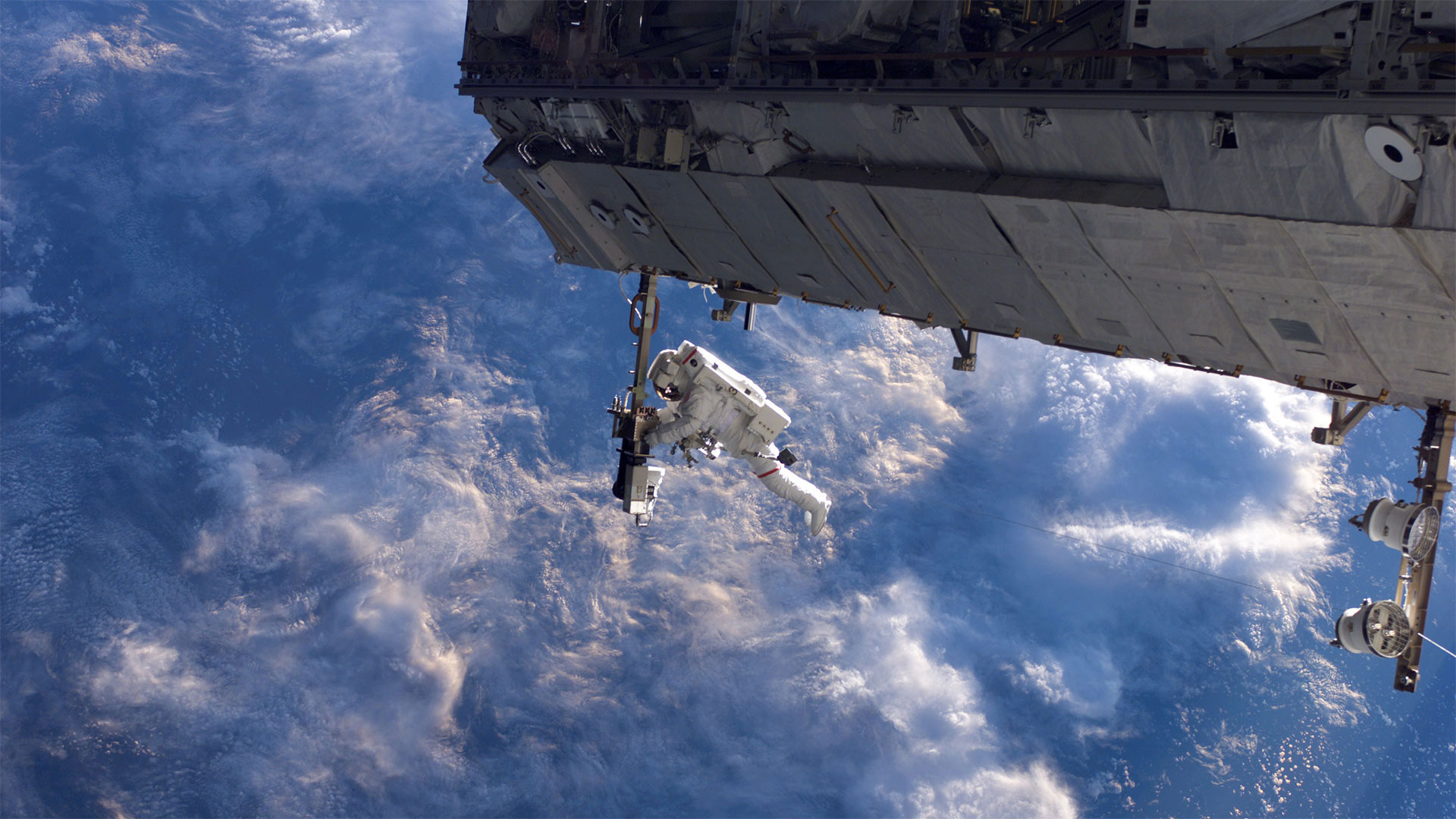
NASA astronaut works on International Space Station during a spacewalk in 2006 (© NASA)
A stroll above the stratosphere
If this photo from 200-plus miles above Earth dizzies you, imagine how it felt to be Alexei Leonov on March 18, 1965. The Soviet cosmonaut achieved the first-ever extravehicular activity (EVA—but you and I just call it a spacewalk). He spent about 20 minutes outside the orbiting Voskhod 2 capsule. It was the ultimate risk: no one knew just what could happen to a human body in the vacuum of space. Near heatstroke, drenched with sweat, and with his suit dangerously inflating, Leonov barely made it back inside the airlock.
Of course, the art of EVA has been perfected since, and that vertigo-inducing panorama is now the view from the office for those aboard the International Space Station. The spacewalker you see here isn't Leonov but NASA's Robert Curbeam busily replacing a faulty component. On this mission in 2006, Curbeam set a record with four EVAs in one spaceflight, spending over 24 hours outside the vehicle. Since the ISS's first spacewalk in 1998, over 227 EVAs have been performed by a large cast of astronauts—including a milestone excursion in 2019 that employed the first all-female crew.
美国宇航局新视野星际探测器拍摄的冥王星新月 Pluto's crescent imaged by NASA's New Horizons interplanetary space probe (© NASA/JHUAPL/SWRI/Science Photo Library)
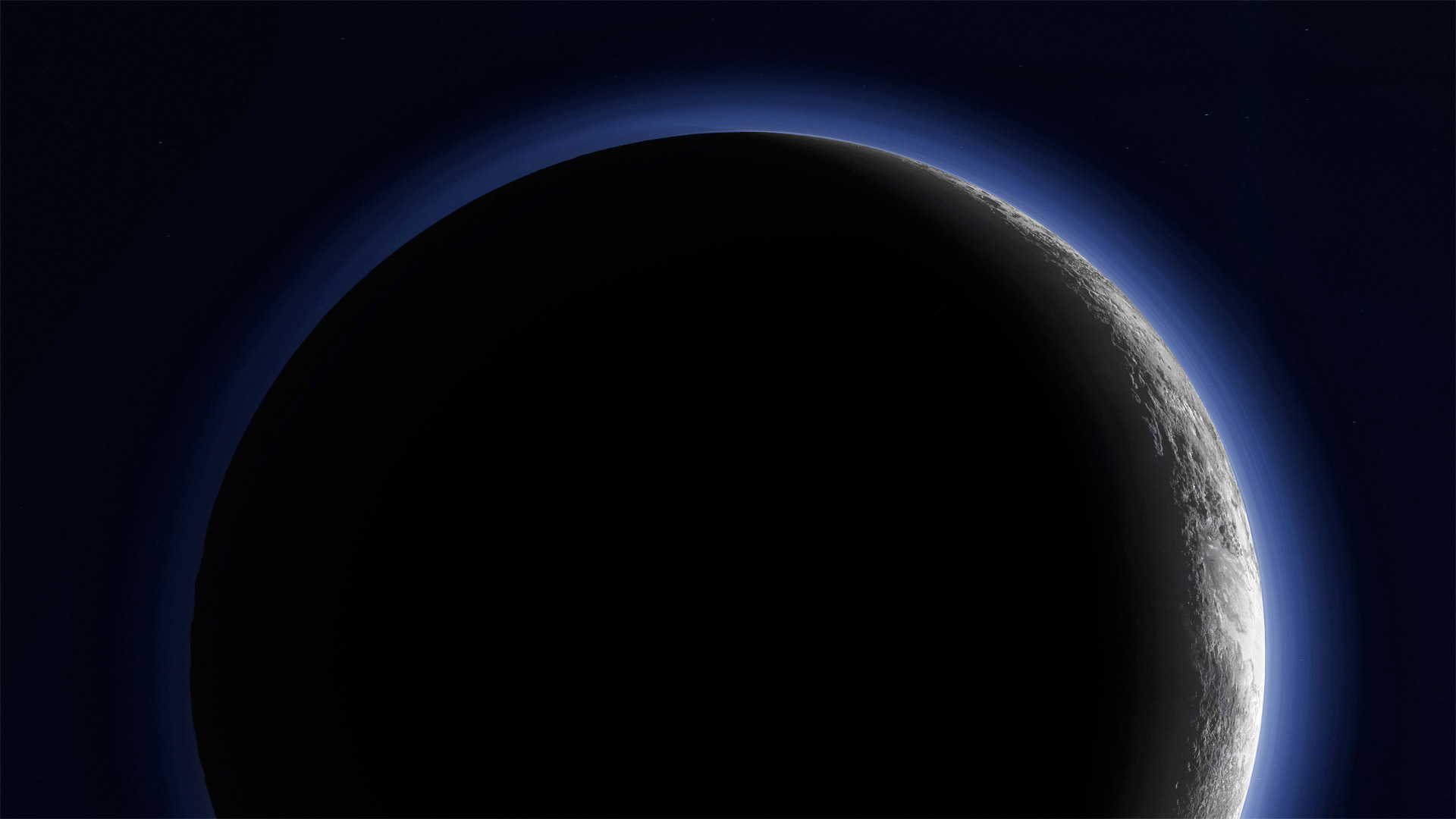
美国宇航局新视野星际探测器拍摄的冥王星新月 Pluto's crescent imaged by NASA's New Horizons interplanetary space probe (© NASA/JHUAPL/SWRI/Science Photo Library)
Too awesome to be a planet
Pluto was first spotted on this day in 1930 by Clyde Tombaugh, a 23-year-old astronomer at Lowell Observatory in Flagstaff, Arizona. Because it’s so far away—about 40 times as far from the sun as Earth is—scientists knew relatively little about Pluto until the New Horizons spacecraft reached it in 2015. In a flyby study, the craft spent more than five months gathering detailed information about Pluto and its moons. What did they find out? There’s a heart-shaped glacier, blue skies, spinning moons, mountains as high as the Rockies, and it snows—but the snow is red.
Once thought to be one of nine full-fledged planets orbiting our sun, in 2006, Pluto was stripped of its planetary status and reclassified as merely a 'dwarf planet.' (Sorry, Pluto.) Though it may no longer be considered a true planet, it’s still the largest dwarf planet of our solar system and holds plenty of mysteries waiting to be discovered.
气泡星云 (NGC 7635) Bubble Nebula (NGC 7635) (© NASA, ESA, and the Hubble Heritage Team STScI/AURA)
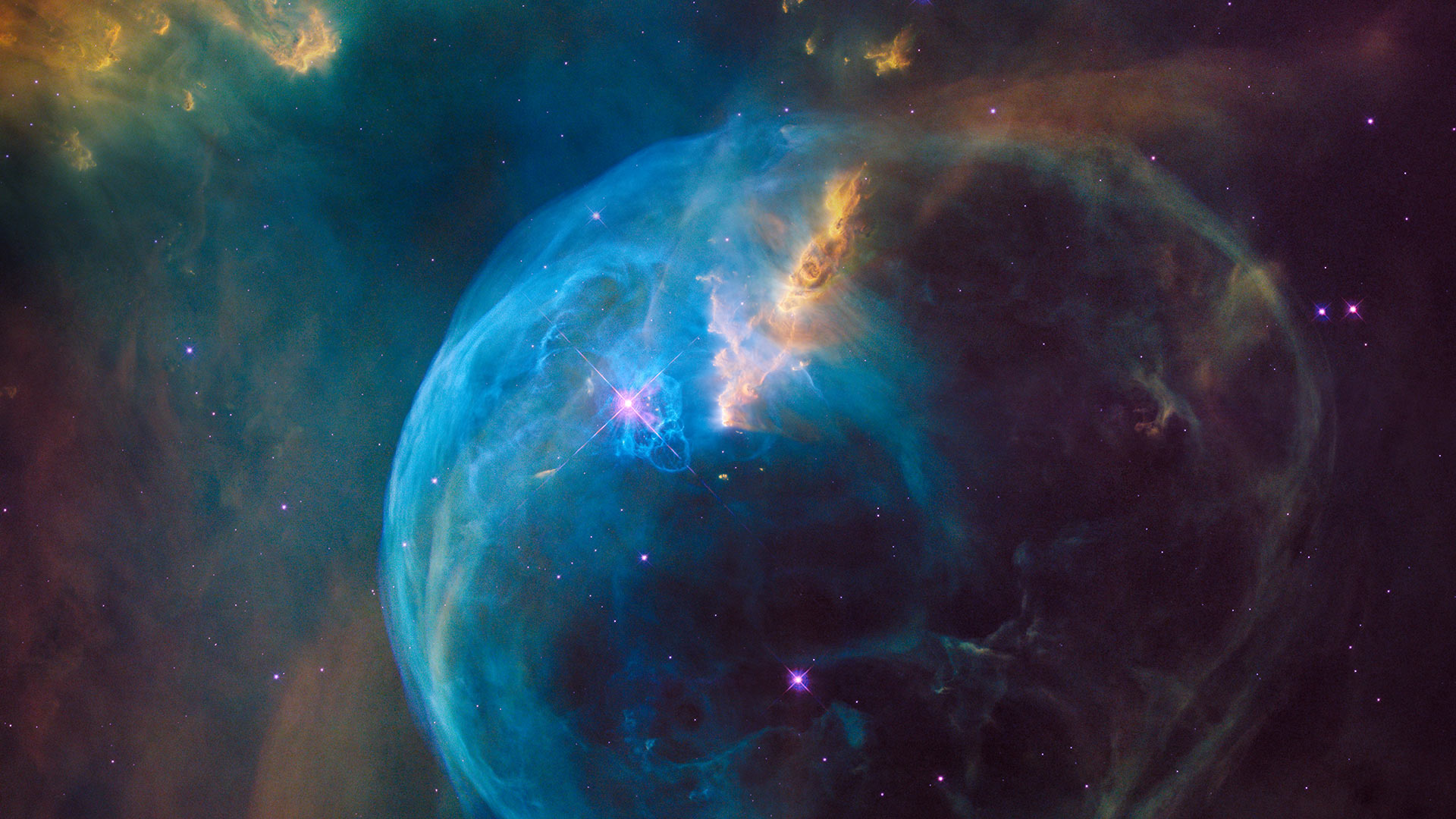
气泡星云 (NGC 7635) Bubble Nebula (NGC 7635) (© NASA, ESA, and the Hubble Heritage Team STScI/AURA)
A star blows a bubble
This giant space bubble is being blown by a massive star visible at the 10 o'clock position inside it. Already over 7 light-years across and expanding at a rate of over 4 million mph, the 'bubble' is actually the shock wave created when expanding hot gas (or stellar wind) hits the cold, interstellar gas that surrounds it. The Bubble nebula was discovered in 1787 by William Herschel. The star inside is living fast and will die young (for a star)—it will likely detonate as a supernova in only 10 to 20 million years. This image was taken in 2016 by the Hubble Space Telescope to mark the 26th anniversary of Hubble's launch into Earth orbit by the STS-31 space shuttle crew. We're showing it to mark the last day of World Space Week, an annual 'international celebration of science and technology, and their contribution to the betterment of the human condition.
木星增强色彩后的一组镜头 Sequence of enhanced-color images of Jupiter (© Enhanced Image by Gerald Eichstädt and Sean Doran, CC BY-NC-SA, based on images provided Courtesy of NASA/JPL-Caltech/SwRI/MSSS)
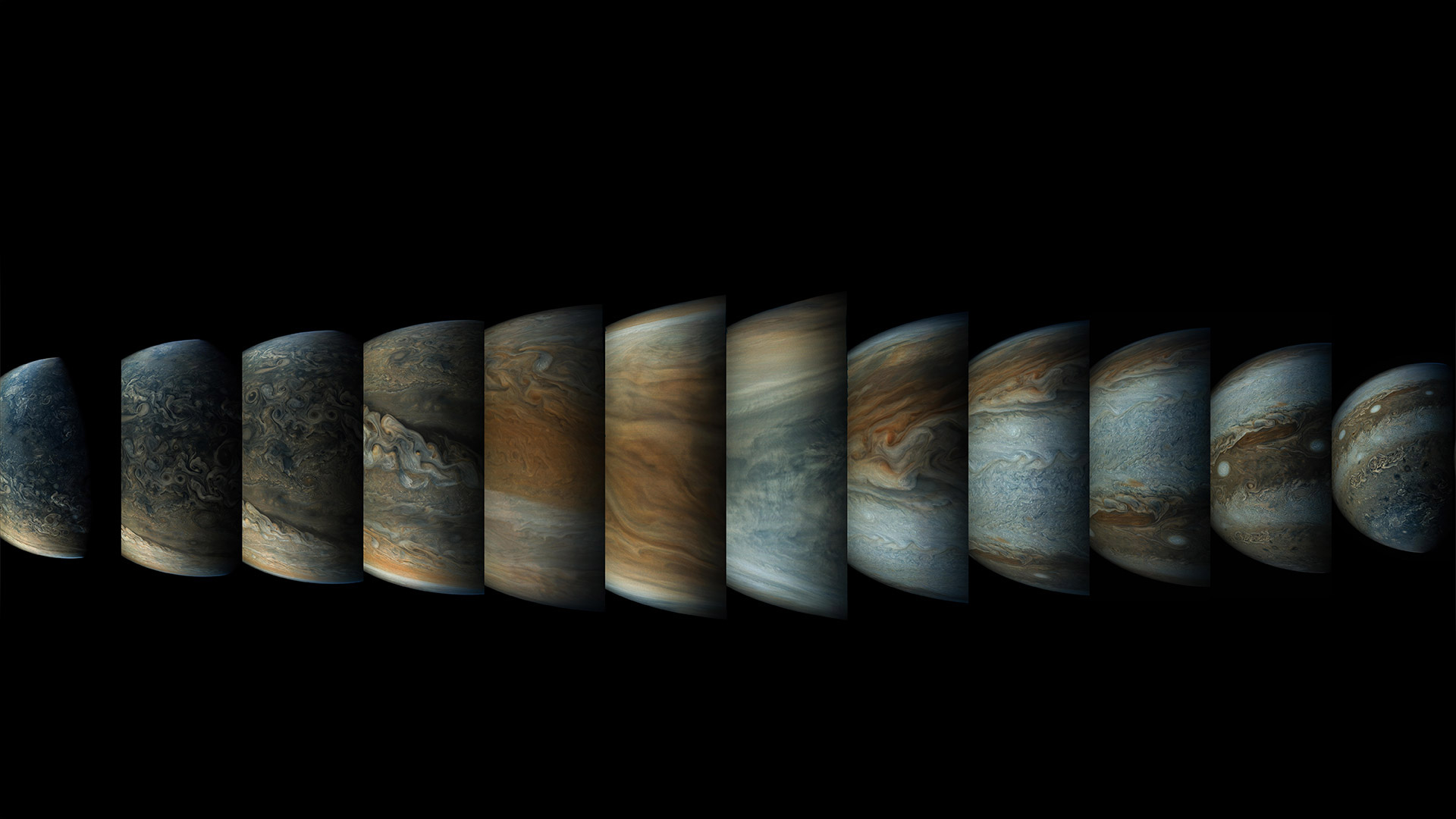
木星增强色彩后的一组镜头 Sequence of enhanced-color images of Jupiter (© Enhanced Image by Gerald Eichstädt and Sean Doran, CC BY-NC-SA, based on images provided Courtesy of NASA/JPL-Caltech/SwRI/MSSS)
Images from NASA's Juno spacecraft as it swoops by Jupiter
For the start of World Space Week, today's homepage features a composite of images taken by NASA's Juno probe as it swooped past Jupiter. Jupiter, the largest planet in our solar system, also has the largest number of moons: 79. Jupiter is the Roman counterpart to Zeus, and so the planet's major moons are named after Zeus's, shall we say, extra-marital partners. So, when it came time to name NASA's most ambitious Jupiter probe, they decided to name it after his wife, Juno, so that she could keep an eye on him. Every 53 days in the course of its wide and complex orbit, the Juno probe makes its closest approach, snapping shots like these as it speeds past the gas giant in just two hours. World Space Week starts on the anniversary of the launch of the very first space probe, Sputnik, which entered orbit around the Earth on October 4, 1957.
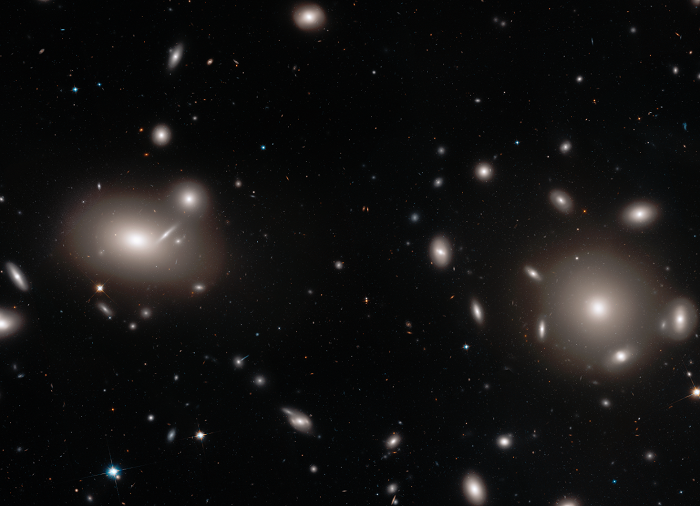
超高分辨率:NASA公布哈勃拍摄的Coma星团拼接照
晚安,开普勒:NASA向开普勒探测器发出最后指令
虽然NASA跟丢了Oumuamua 但该神秘天体不是外星探测器
2018年 10 月,天文学家利用夏威夷的巡天望远镜 Pan-STARRS1 发现了人类已知的第一颗星际天体 `Oumuamua。`Oumuamua 有着雪茄外形,与我们在太阳系观察到的天体存在显著差异,它正在加速远离太阳系。多个地面望远镜和哈勃太空望远镜对其进行的观察推测这颗天体的长度小于 800 米。
现在,NASA 的研究人员报告了 Spitzer 望远镜对 `Oumuamua 的观察结果:结果是没有观察到,因为它微弱了。
虽然没有观察到,但科学家据此能推断出 `Oumuamua 新的长度上限,他们认为它的长度在 100 米到 440 米之间,比以前估计的小。

较小的体积可能有助于解释围绕 `Oumuamua 的谜团,也就是究竟是什么推动它加速离开太阳系: `Oumuamua 接近太阳产生的气体可能起到加速的作用。